In today’s digital world, customers often search online before choosing a business. Whether you run a boutique, a restaurant, a consultancy, a training institute, or a local service company, having a professional website can help customers discover your business and understand what you offer.
However, many small-business owners believe that building a website requires a large investment. This can make them delay creating their online presence.
The good news is that affordable website development in India makes it possible for small businesses to build a professional online presence without investing in unnecessary features from the beginning.
With the right planning, you can start with a simple, useful website and expand it as your business grows.
In this guide, we will explain how to plan your website, choose the right features, manage your budget, and select a website development company that understands your business needs.
What Is Affordable Website Development?
Affordable website development means creating a website that meets your business requirements while staying within your budget.
It does not mean choosing the cheapest option without considering quality. A good affordable website should be easy to use, mobile-friendly, simple to navigate, and designed to help visitors understand your products or services.
For example, a small boutique may need a website that displays its collections, business address, contact details, and WhatsApp enquiry option. It may not need a complete e-commerce system at the beginning.
By selecting only the features your business needs, you can control the initial development cost.
Why Does Your Small Business Need a Website?
A website gives your business a dedicated online space where customers can learn about your services and contact you.
1. Build a Professional Business Image
A well-designed website helps present your business information in an organised manner. Customers can explore your services, view your work, and find your contact details in one place.
For example, a consultancy can use its website to explain its services, introduce its team, and provide an enquiry form.
2. Help Customers Find Your Business Online
Customers may search Google for products and services in their area. A website with relevant content and local business information can support your visibility in search results.
For instance, a bakery in Madurai can create pages explaining its products, service area, opening hours, and ordering process.
A website alone does not guarantee higher Google rankings. Search engine optimisation (SEO), useful content, website performance, and other factors also matter.
3. Showcase Your Products and Services
Your website can work as a digital catalogue that customers can access whenever they need information.
You can display:
- Products and service descriptions
- Photos and project examples
- Pricing or package details
- Customer enquiry options
- Business location and contact information
This makes it easier for potential customers to understand what your business offers.
4. Make Customer Enquiries Easier
A website can include direct contact options such as WhatsApp buttons, phone links, enquiry forms, and email links.
For example, a home interior business can showcase completed projects and include a button that allows visitors to request a quotation through WhatsApp.
5. Support Your Digital Marketing Activities
If you run social media campaigns or Google Ads, your website can serve as the destination for interested customers.
Instead of relying only on social media messages, you can direct visitors to a dedicated page that explains your offer and provides a clear next step.
What Type of Website Does Your Business Need?
Before investing in website development, identify what you want the website to achieve.

1. Static Business Website
Suitable for consultants, local service providers, small companies, and startups.
Typical features: Home, About, Services, Contact, enquiry form and WhatsApp button.

2. E-commerce Website
Suitable for businesses that want to sell products online.
Typical features: Product listings, product details, shopping cart, checkout and payment integration.

3. Web Application
Suitable for businesses that need more than a standard informational website.
Typical features: Login accounts, dashboards, data management, reports and customised workflows.
Choosing the right type of website helps you avoid paying for features that do not support your current business goals.
How Much Does Affordable Website Development Cost in India?
Website development costs vary according to the type of website, design requirements, number of pages, functionality, integrations, and ongoing support.
Rather than choosing a package based only on price, understand what is included in the total cost.
| Website type | What affects the cost? |
|---|---|
| Basic business website | Number of pages, design, contact forms and responsiveness |
| Business website with additional features | Animations, galleries, integrations and custom sections |
| E-commerce website | Product catalogue, inventory, checkout and payment gateway |
| Custom web application | User roles, database, dashboards and business logic |
What additional expenses should you consider?
Website development may not be the only expense. Ask whether your quotation includes:
- Domain registration and renewal
- Web hosting and renewal
- SSL certificate
- Business email setup
- Premium themes or plugins, if required
- Third-party integrations
- Maintenance, backups and technical support
Some providers include selected items in their packages, while others charge separately. Always confirm the terms before making a decision.
How can you keep your website budget under control?
Start with essential features. A small business may initially need only a homepage, service pages, an About section, and contact options.
Prepare your content in advance. Having your logo, business description, images, contact details, and service information ready can help reduce delays and unnecessary revisions.
Choose scalable solutions. Where appropriate, build a website that can be expanded with additional pages or features when your business needs them.
Understand the quotation. Ask for a clear breakdown of development costs, recurring expenses, add-ons, and maintenance.
Affordable website development should provide a practical starting point without creating unexpected costs later.
Essential Features of a Professional Small-Business Website
Even a budget-friendly website should cover the basics that help visitors understand your business and take action.
Mobile-Friendly Design
Many visitors access websites using smartphones. Your website should adapt to different screen sizes, with readable text, clear navigation, and buttons that are easy to tap.
Clear Service or Product Information
Explain what you offer, who your services are for, and how customers can get started. Use straightforward language instead of lengthy technical descriptions.
Contact Details and WhatsApp Integration
Display your phone number, email address, business location where relevant, and convenient enquiry options. A WhatsApp button can make it easier for customers to start a conversation.
Basic SEO Setup
A website should have descriptive page titles, relevant headings, meaningful page content, appropriate image descriptions, and a structure that search engines can understand.
You can also set up Google Search Console to monitor search performance and identify indexing issues.
Fast Loading and Secure Connections
Optimise images, avoid unnecessary features, and use suitable hosting. An HTTPS connection helps protect data exchanged between the visitor’s browser and the website, although additional security measures may also be needed.
Easy Content Updates
Choose a suitable platform and development approach that allows your business to update content without rebuilding the entire website whenever a small change is required.
How to Choose the Right Website Development Company
Choosing a website development partner is just as important as selecting the right package.
Before finalising a company, consider these factors.
1. Review its portfolio. Look at websites the company has developed and check whether the design, layout, and functionality meet your expectations.
2. Ask for a detailed quotation. The quotation should explain the number of pages, included features, delivery timeline, payment terms, and any additional charges.
3. Check mobile compatibility. Ask to see how its websites look on both desktop and mobile devices.
4. Understand ownership and access. Confirm who will own the domain, hosting account, website files, and administrative credentials.
5. Discuss maintenance. Find out whether updates, backups, security checks, and technical support are included or charged separately.
6. Confirm the delivery process. Agree on what content you must provide, how revisions will work, and what conditions apply to the delivery date.
A reliable development partner should explain the process clearly and recommend features based on your business requirements rather than simply selling the most expensive package.
Can You Build a Website Within 24 Hours?
A simple website can sometimes be delivered within 24 hours when the requirements are clearly defined, the content and images are ready, and the project does not require complex functionality.
However, the timeline depends on the scope of work, integrations, design approvals, and testing.
For example, a small business that has already prepared its logo, service descriptions, contact details, and images may be able to complete a straightforward website much faster than a business that still needs to finalise its content.
E-commerce platforms, custom applications, payment integrations, and other complex requirements generally need additional planning and development time.
Before agreeing to a deadline, ask your developer to confirm the scope and delivery conditions in writing.
Practical Example: A Local Boutique Building Its Online Presence
Consider a boutique in Madurai that currently receives enquiries through Instagram and WhatsApp.
The owner wants customers to view available collections, understand the boutique’s services, and contact the business without visiting the shop first.
Instead of immediately investing in a large e-commerce platform, the boutique could start with a business website that includes:
- A homepage introducing the boutique
- A gallery of clothing collections
- Information about products and services
- Business address and contact details
- A WhatsApp enquiry button
- Basic SEO and mobile-friendly design
The boutique can later consider product filtering, online payments, inventory management, and delivery features if online sales become a priority.
This approach allows the business to establish a professional online presence while keeping the initial scope manageable.
The same principle can work for restaurants, coaching centres, consultants, interior designers, training institutes, and other small businesses.
Why Consider Zayith Technologies for Website Development?
Zayith Technologies provides technology solutions for businesses looking to establish or improve their digital presence.
If you are planning to build a business website, the first step is to identify your requirements, preferred features, budget, and timeline.
The right website solution should match your business goals and give you a clear understanding of what you are paying for.
Whether you need a basic business website, a more feature-rich website, or a custom web application, discuss your requirements before selecting a solution.
Explore the Zayith Technologies website to learn more about the company’s services.
Zayith Technologies’ website development offering starts from 3000, with the final cost depending on the required features and package inclusions.
If you are looking for affordable website development in India, contact Zayith Technologies to discuss your business needs and get clarity on the available options.
Ready to build your business website?
Visit zayithtech.com to get started.
Frequently Asked Questions (FAQs)
1. How much does affordable website development cost in India?
The cost depends on the website type, number of pages, design requirements, and functionality. A basic business website generally requires a smaller scope than an e-commerce website or custom web application. Request an itemised quotation to understand the complete cost.
2. Can I build a professional website with a small budget?
Yes. You can begin with essential pages, mobile-friendly design, business information, and contact options. Additional features can be introduced later as your business grows.
3. How long does it take to develop a business website?
The timeline depends on the project’s complexity and how quickly the required content and approvals are provided. A simple website may be completed quickly, while custom websites and applications generally require more time.
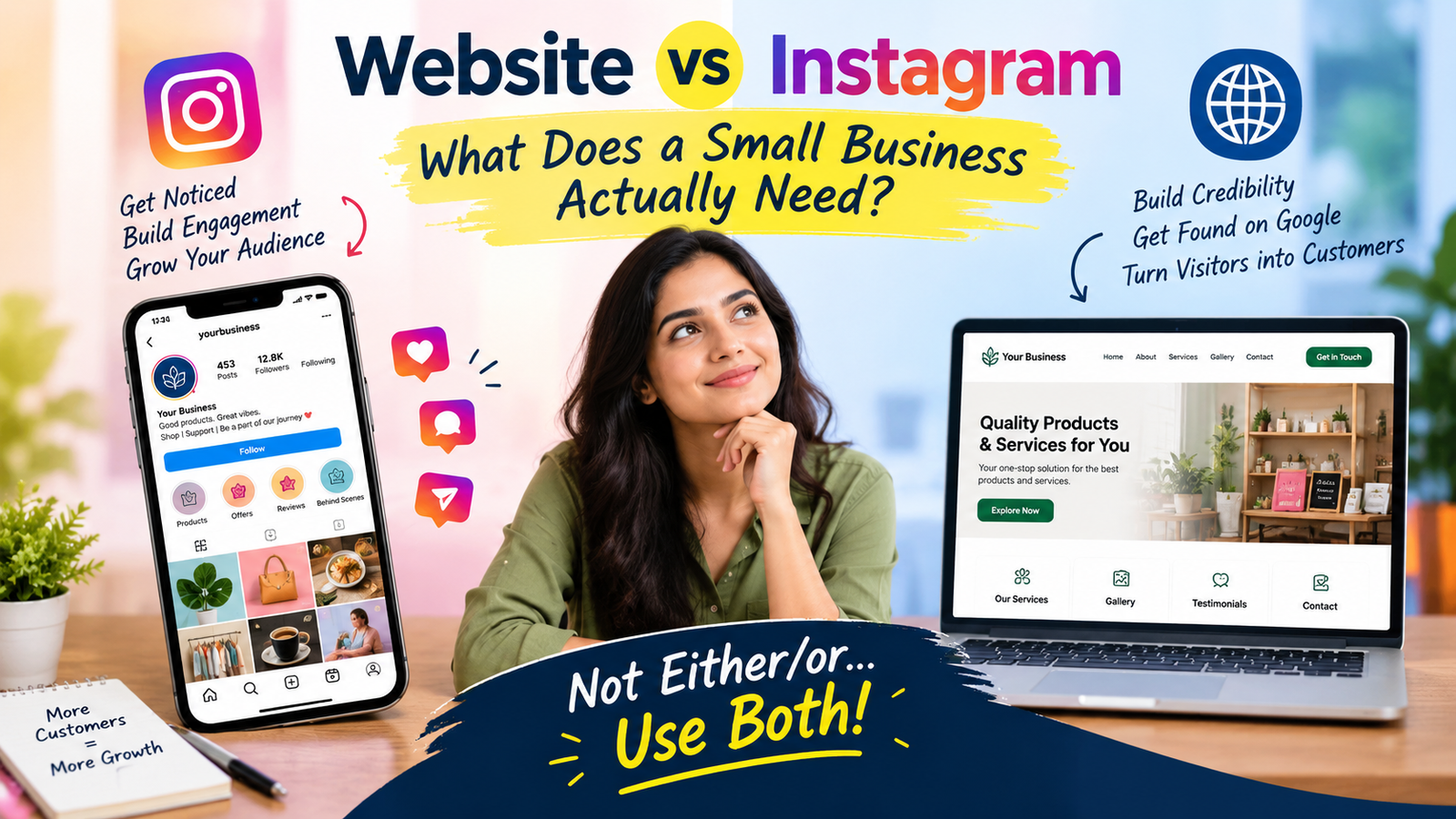
4. Is a website better than an Instagram business page?
They serve different purposes. Instagram helps businesses share content and interact with followers, while a website provides a dedicated place for detailed business information, service pages, and enquiries. Many businesses benefit from using both.
5. Does my small business website need SEO?
SEO can help search engines understand your website and help potential customers discover relevant pages. Basic SEO is a useful starting point, although search visibility depends on several factors and cannot be guaranteed.
6. Do I need to pay for website maintenance every year?
It depends on your hosting plan, domain registration, software, and support arrangements. Some services have recurring charges, so confirm which expenses are included in your development package and which require renewal.
7. Can I add online payments to my website later?
Yes, if your chosen platform and website architecture support the required integration. Payment gateway setup, transaction charges, and other integration costs may apply.
8. What should I prepare before contacting a website developer?
Prepare your business name, logo, service or product details, contact information, reference websites, available images, preferred features, and budget. These details help the developer understand your requirements and prepare a suitable proposal.